

The Rough Guide to London
-

With a population of just under eight million, London is Europe's largest city, spreading across an area of more than 620 square miles from its core on the river Thames. Ethnically it's also Europe's most diverse metropolis: around two hundred languages are spoken within its confines, and more than thirty percent of the population is made up of first-, second-, and third-generation immigrants. Despite Scottish, Welsh and Northern Irish devolution, London still dominates the national horizon, too: this is where the country's news and money are made, it's where the central government resides and, as far as its inhabitants are concerned, provincial life begins beyond the circuit of the city's orbital motorway. Londoners' sense of superiority causes enormous resentment in the regions, yet it's undeniable that the capital has a unique aura of excitement and success - in most walks of British life, if you want to get on you've got to do it in London.
For the visitor, too, London is a thrilling place - and in the last few years, the city has been in a relatively buoyant mood. Thanks to the national lottery and the millennium-oriented funding frenzy, virtually every one of London's world-class musuems, galleries and insttutions has been reinvented, from the Royal Opera House to the British Museum. [...]
What to see
Stetching for more than thirty miles at its broadest point, London is a big place. the majority of its sights are situated to the north of the River Thames, which loops through the city from west to east. However, there is no single predominant focus of interest, for London has grown not through centralized planning but by a process of agglomeration - villages and urban developments that once surrounded the core are now lost within the amorphous mass of Greater London.
One of the few areas that you can easily explore on foot is Westminster and Whitehall, the city's royal, poitical and ecclesiastical power base, where you'll find the National Gallery and a host of other London landmarks, from Buckingham Palace to Westminster Abbey and Big Ben. The grand streets and squares of Saint James's, Mayfair and Marylebone to the north of Westminster have been the playground of the rich since the Restoration, and now contain the city's busiest shopping zones.

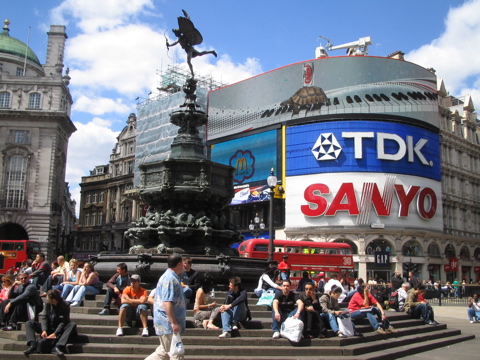
East of Picadilly Circus, Soho, Chinatown and Covent Garden are also easy to walk around and form the heart of the West End entertainment district, containing the largest concentration of theatres, cinemas, clubs, flashy shops, cafés and restaurants. To the north lies the university quarter of Bloomsbury, home to the ever-popular British Museum, and , to the east, the secluded quadrangles of Holborn's Inns of Court, london's legal heartland.
The City - the City of London, to give it its full title - is at one and the same time the most ancient and the most modern part of London. Settled since Roman times, it is now one of the world's great financial centers, yet retains its share of historic sights, notably the Tower of London and a fine caché of Wren churches that includes Saint Paul's Cathedral. Despite creeping trendification, the East End, to the East of the City, is not conventional tourist territotry, but to ignore it entirely is to miss out a crucial element of contemporary London. Docklands is the converse of the down-at-heel East End, with Canary Wharf's skyscrapers, including the country's tallest building, epitomizing the pretensions of the smash-and-grab cutlure that has gripped the nation since the 1980s.
A small slice of central london south of the Thames is definitely worth exploring. First off, there's the South Bank Centre, London's little-loved concrete culture bunker, which is enjoying a new lease of life thanks to inspired artistic direction and its proximity to the giant observation wheel known as the London Eye. Further east, along the river in bankside is the Tate Modern, one of the world's greatest modern art museums, now linked to the City by the funky pedestrian-only millennium bridge.
The largest segment of greenery in central London is Hyde Park, which separates wealthy Kensington and Chelsea from the city centre. The museums of south Kensington- the Victorian and Albert Museum and the Natural History Museum - are a must, and if you have shopping on your agenda, you'll want to check out the hive of plush stores in the vicinity of Harrods.
The capital's most hectic weekend market takes place around Camden Lock in north London. Further out, in the literary suburbs of Hampstead and Highgate, there are unbeatable views across the city from half-wild Hampstead Heath, the favourite parkland of thousands of Londoners. The glory of South London is Greenwich with its nautical associations, royal park and observatory (not to mention its Dome). Finally, there are plenty of rewarding day-trips along the Thames from Chiswick to Windsor, most notably Hampton Court Palace and Windsor Castle.

Publicité